How to secure your driveway: 5 ways that work
The best driveway security stops the car leaving, makes thieves easy to see, and keeps your keys out of reach. Here are five ways to do that, roughly in order of how much difference they make for a car parked on the drive overnight.
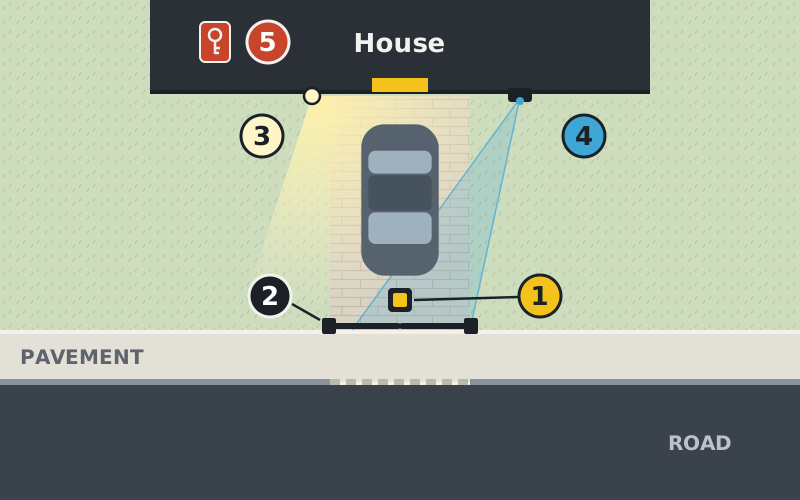
- A security post in front of the car. It can't be driven off, even if a thief gets in and starts it.
- Gates, closed at night. They make the car harder to reach and slower to take.
- A low light on a dusk-to-dawn switch. It keeps the drive lit without bothering the neighbours.
- A camera mounted high, pointed at your own property.
- Keys away from the front door, with keyless keys in a signal-blocking pouch.
1. A security post in front of the car
A telescopic bollard locked upright in front of the car means it can't be driven off, even if a thief gets in and starts it. Secured by Design suggests a bollard on drives without gates, and Cheshire police suggest collapsible bollards for keyless and high-value cars.
Look for a post set in concrete with a proper lock, and check for a Sold Secure rating, which has a category for security posts. Every way a car could leave the drive needs covering. If there's a lawn or a low wall it could cross, that needs a post too. Fitted prices start at £629.
2. Gates
Gates closed at night make a car harder to reach and slower to take. Secured by Design recommends closing them whenever the car isn't in use.
Two things to check first. Planning: in England, a gate next to a road can usually be up to 1 metre high without planning permission, so most front gates taller than that need it. Listed buildings and conservation areas have extra rules. And cost: MyBuilder puts manual gates at £700 to £3,500 and electric gates at £1,800 to £8,500. Checkatrade gives about £5,000 on average for electric gates.
Low front boundaries have an upside too. The Met Police say a front boundary around 1 metre high lets people see in, so there's nowhere to hide.
3. Lighting
The Met Police suggest a low, white light on a dusk-to-dawn switch, placed so it doesn't bother the neighbours. Avon and Somerset Police make the same point: motion sensor lights get set off by cats and visitors, so a constant low light can work better. Keep plants trimmed so they don't block it.
4. CCTV and doorbell cameras
Cameras help after the event and can put some thieves off. Thames Valley Police say CCTV won't stop a burglary on its own. Mount cameras high and point them at your own property.
If your camera captures the street, a neighbour's home or shared space, data protection law applies, according to the ICO. That means having a clear reason, recording no more than you need, putting up a sign, keeping footage secure and deleting it regularly. The same applies to smart doorbells.
5. Keys and habits
- Keep keys away from the front door, including spares. Thieves fish through letterboxes, and relay theft is easier when the key is near the door. A letterbox guard helps.
- Use a signal-blocking pouch for keyless keys, and test it every few months, as Hampshire police advise.
- Use a steering lock as a visible extra.
- Block the more valuable car in. Cheshire police suggest blocking in keyless or high-value cars at home, for example with the other car.
What about gravel?
The Met Police and Thames Valley Police both say gravel is noisy underfoot, so you'll hear people coming. But The Crime Prevention Website points out there's no research proving it stops crime. It's a nice extra, not a fix. Bollards fit gravel drives too.
Where to start
If you do one thing, stop the car leaving. Gates and bollards both do that; a bollard costs a fraction of an electric gate and doesn't need planning permission on most private drives. Then add lighting and good key habits. Our guide to which bollard you need helps you pick.
Questions people ask
Do I need planning permission for driveway gates? Often. In England, a gate next to a road can usually be up to 1 metre high without permission. Check with your council, especially for listed buildings and conservation areas.
Is my doorbell camera legal? Yes, but if it captures beyond your property, data protection law applies. The ICO says you need a clear reason, a sign, secure storage and regular deletion.
What's the cheapest way to secure a driveway? Good key habits cost almost nothing. For a physical barrier, a fold-down post starts at £279 fitted, and a telescopic security bollard at £629.
Sources
- Secured by Design: car security
- Cheshire police advice via Frodsham Town Council
- Planning Portal: fences, gates and garden walls
- MyBuilder: driveway gate cost, Aug 2026
- Checkatrade: electric gate prices, Jun 2026
- Metropolitan Police: keep burglars out
- Avon and Somerset Police: lighting
- Thames Valley Police: home security guide
- ICO: home CCTV systems
- Hertfordshire Constabulary: Operation Remote
- Hampshire Constabulary: preventing vehicle theft
- The Crime Prevention Website: noise in the garden
Want a fixed price for your drive?
Get your fixed, fitted price in 60 seconds and book your date online. Ian tells you which post, how many and where.